- Client
- A mining company in Central Africa (anonymised)
- Sector
- Mining
- Location
- Central Africa
- Year
- 2026
Screening great apes for disease risk on an active mining permit
We helped a mining company improve its understanding of the health of the threatened great apes on its permit, without handling a single animal, and plan clearing works around them.
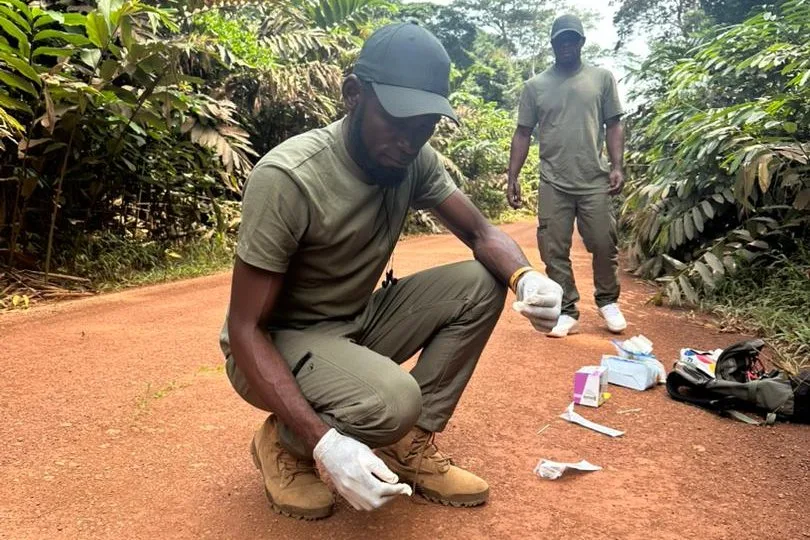
Non-invasive sampling: no animals were handled. © Okala
174
non-invasive samples collected
3 weeks
of field sampling
0
animals handled
The challenge
The client wanted a better understanding of the health of the gorillas and chimpanzees living on its permit, including whether they carried yaws, a bacterial disease that can also affect people. Wildlife health matters for the conservation of these threatened apes, for worker safety and for IFC PS6 compliance. Planned clearing works also needed protected-species checks before they could go ahead.
What we did
Over three weeks in 2025, our field team and specialist ape trackers collected 174 fresh faecal and urine swabs (150 from gorillas and 24 from chimpanzees) under strict contamination control, with dual preservation and full chain of custody. Samples were tested by the Helmholtz Institute for One Health. Our team also ran pre-clearance surveys of plants, mammals and birds in the areas due to be cleared. All fieldwork was carried out within the client's HSE management system, with our teams working safely alongside active site operations.
The outcome
The client received clear laboratory answers on yaws, along with practical measures to reduce disturbance to great apes during exploration and clearing, such as buffers around nests and feeding trees, quiet hours and pre-clearance checks. It also has a plan for more targeted follow-up sampling, all aligned with IFC PS6 and a One Health approach.